
Sourdough Croissant Bread
This stunning sourdough croissant bread combines the best of buttery croissants and rustic sourdough bread for only a fraction of the work!
Print
Pin
Servings: 16 slices
Calories: 170kcal
Ingredients
- 100 g sourdough starter active and bubbly (about 1 cup after rising, ½ cup stirred down)
- 350 g water room temperature (about 1 ½ cups)
- 500 g all-purpose flour about 4 cups
- 15 g salt about 2 ½ teaspoons
- 113 g unsalted butter frozen or very cold* (about 1 stick, or ½ cup)
Instructions
Cook Mode- In a large mixing bowl, gently whisk the water and sourdough starter to combine.
- Make the dough. Add the flour and salt. Mix until a shaggy dough forms, then cover and allow to rest for 30 minutes.
- Grate the butter. We recommend using frozen butter for this step. Use a box grater to grate the butter onto a plate or shallow bowl. Place the grated butter in the freezer to keep cold until you’re ready to do the stretch and folds**.
- Incorporate the butter. After the dough has rested for 30 minutes, sprinkle a third of the grated butter on top of the shaggy dough. Gently fold the dough a few times to cover the butter. Repeat this process until all of the butter has been added to the dough. The dough will look lumpy and uneven, which is expected.
- Rest the dough. Cover and allow to sit for 30 minutes.
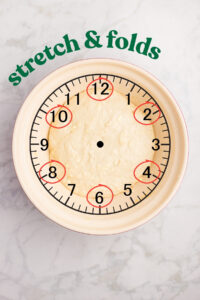
- Stretch and folds. Over the next 2 hours, perform 4 sets of stretch and folds** every 30 minutes. The dough will become smoother and more elastic with every stretch and fold session.
- First proof (rising). Cover and allow the dough to rise at room temperature until puffy, increasing its volume by 60-75 percent. This could take anywhere between 4-8 hours depending on the strength of your starter and the temperature of your kitchen.
- Shape the dough. Transfer the dough to a surface dusted with flour, and shape it gently into a boule by folding the edges inward and tightening the surface. Try not to press out all the air or smear the butter into the dough.
- Place seam-side up into a floured banneton or towel-lined bowl.
- Cold fermentation. Cover and refrigerate overnight, about 10-14 hours. (This allows the butter to firm back up and will improve the flaky texture). If needed for timing purposes, you can refrigerate the dough for up to 24 hours before baking.
The next day:
- Preheat the oven to 475ºF (240ºC) with a Dutch oven inside for at least 45 minutes.
- Turn the dough onto a piece of parchment paper and score the top with a lame, a blade, or a sharp knife.
- Place 3-4 ice cubes in the bottom of the Dutch oven, and immediately transfer the dough (using the parchment paper or silicone liner) to the preheated Dutch oven. Place the lid on tightly and place in the oven.
- Bake with the lid on for 25 minutes.
- Remove the lid and reduce the temperature of the oven to 375ºF (190ºC). Bake for another 25 minutes, or until the bread has an internal temperature of 205-210ºF (96-99ºC).
- The loaf should sound hollow and have a nice golden crust. Remove it from the Dutch oven and place on a cooling rack.

- For the best results and best texture, let the bread cool for 2 hours before slicing.
Notes
Chocolate Chip Sourdough Croissant Bread: Add 1 cup of chocolate chips to the dough during the shaping process and before the cold fermentation. All other ingredients and instructions remain the same. It tastes AMAZING!
**Stretch and folds: If you have not performed stretch-and-folds before, this is done by dividing the bowl like a clock. Start at 12:00 (the top of the bowl), and use your hand to pull up a section of the dough as far as it will stretch without breaking, then fold it over into the middle. Repeat this for intervals of the “clock”. Depending on the type of dough, you may be able to do this at 12:00, 2:00, 4:00, 6:00, 8:00, and 10:00. If the dough is very thick or stiff, you might only be able to do 12:00, 3:00, 6:00, and 9:00. This should be repeated every 30 minutes unless otherwise stated in the recipe. The dough will become stretchier with each series of stretch and folds.
Storage: Store the bread loosely wrapped or in a paper bag at room temperature for up to 3 days. For longer storage, slice and freeze the bread in an airtight freezer-safe bag for up to 2 months.
Reheating: Warm slices in a toaster or bake the loaf at 350ºF (180ºC) for 8-10 minutes to refresh the crust and flaky texture.
COLD butter: In order to get the super flaky texture rather than just a simple enriched dough effect, you must use very cold grated butter. We recommend freezing it, as just the warmth from your hand can melt the butter during grating. We use a box grater, but a food processor would work just fine.
Nutrition
Serving: 1slice | Calories: 170kcal | Carbohydrates: 25g | Protein: 3g | Fat: 6g | Saturated Fat: 4g | Polyunsaturated Fat: 0.3g | Monounsaturated Fat: 2g | Trans Fat: 0.2g | Cholesterol: 15mg | Sodium: 366mg | Potassium: 35mg | Fiber: 1g | Sugar: 0.1g | Vitamin A: 176IU | Calcium: 7mg | Iron: 1mg
